Kit Car History: Early Fiberglass Makers and the 1960s Boom
The kit car industry as we know it today owes its existence to a revolutionary material: fiberglass. While enthusiasts had been building custom vehicles from the early 20th century using mail-order cyclecars and designs from publications like The English Mechanic, the modern kit car movement truly began when affordable fiberglass molding transformed what was possible for small manufacturers and home builders alike.
But who were the pioneers that first recognized fiberglass's potential for automotive bodies? And how big did the industry actually become during its golden age in the 1960s and 1970s? Let's explore the documented history with names, dates, and numbers.
The Birth of Fiberglass Kit Cars: Bill Tritt and Glasspar (1949-1951)
The credit for the first commercial fiberglass car body in the postwar era belongs to American boat builder Bill Tritt. In 1949, Tritt founded Glasspar Company in Santa Ana, California, initially producing fiberglass boat hulls. His expertise with the material led him to experiment with automotive applications.
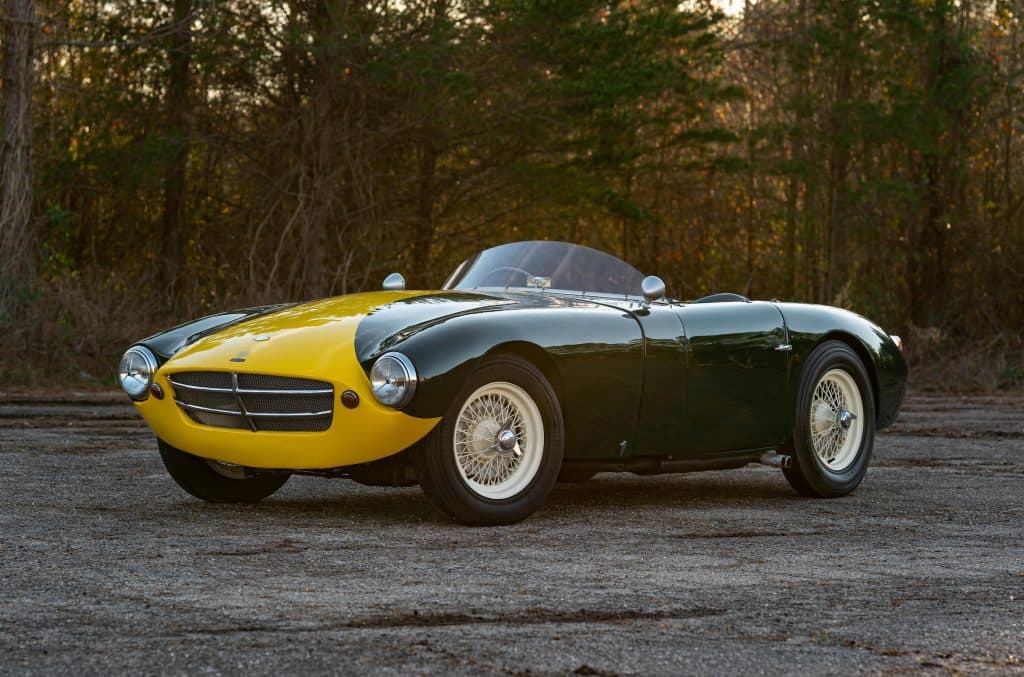
By 1951, Tritt introduced the Glasspar G2, a sleek two-seater sports car body designed to be mounted on various chassis. The G2 represented a watershed moment in automotive history:
- • First commercially available fiberglass sports car body in the United States
- • Designed to fit on modified Ford or Willys chassis
- • Approximately 200+ units produced between 1951 and 1955
- • Price: around $950 for the body kit alone
The Glasspar G2's success demonstrated that fiberglass offered compelling advantages over traditional steel bodies: it was lightweight, rust-resistant, and could be molded into complex curves that would be prohibitively expensive to stamp in metal. Perhaps most importantly for the emerging kit car industry, fiberglass molds were relatively inexpensive to produce, making small-batch manufacturing economically viable.
Fiberglass Goes Mainstream: The Lotus Elite Type 14 (1957-1963)
While Glasspar proved the concept in America, it was British manufacturer Lotus that demonstrated fiberglass could be used for sophisticated, high-performance vehicles. The Lotus Elite Type 14, unveiled at the 1957 Earls Court Motor Show, featured a groundbreaking fiberglass monocoque chassis/body unit — the first production car to use this construction method.
Lotus Elite Type 14 Production Data
- • Production Period: 1957-1963
- • Series 1 Units: 281 (1957-1960)
- • Series 2 Units: 749 (1960-1963)
- • Total Production: 1,030 units
- • Designer: Peter Kirwan-Taylor
- • Aerodynamicist: Frank Costin
- • Drag Coefficient: 0.29 (exceptional for the era)
- • Weight: 673 kg (1,483 lbs)
- • Engine: 1,216cc Coventry Climax FWE, 75 hp
The Elite's racing success — including victories at Le Mans with drivers like Jim Clark (1959), Ian Walker, and Sir John Whitmore — proved that fiberglass construction could compete at the highest levels of motorsport. This legitimized the material in the eyes of both enthusiasts and manufacturers.
The Rise of British Kit Car Pioneers (1958-1960s)
The late 1950s saw several British manufacturers embrace fiberglass for kit and low-volume production cars:
TVR (founded 1947, fiberglass bodies from late 1950s) began producing fiberglass-bodied sports cars that enthusiasts could purchase as complete vehicles or partial kits.
Ginetta, established in 1958 by the Walklett brothers in Woodbridge, Suffolk, became one of the most prolific kit car manufacturers. Their early models used fiberglass bodies on Ford-based mechanicals, a formula that would define the British kit car industry for decades.
Rochdale Motor Panels (founded 1948) was another early British pioneer, offering fiberglass body shells that could transform ordinary saloon car mechanicals into sporty two-seaters.
The Golden Age: Quantifying the 1960s-70s Boom
The kit car industry experienced explosive growth during the 1960s and 1970s, driven by several converging factors:
The Volkswagen Beetle: The Ultimate Donor Car
The Volkswagen Beetle became the foundation for countless kit cars. With over 21.5 million units produced between 1938 and 2003, Beetles offered:
- • Abundant availability and low prices for used examples
- • Simple, robust air-cooled mechanicals
- • A flat floorpan ideal for fiberglass body mounting
- • Easily accessible parts supply
The Beetle's platform spawned hundreds of kit car designs, from dune buggies like the Meyers Manx (introduced 1964) to exotic replicas mimicking Ferrari and Porsche styling.
Market Size and Manufacturer Numbers
By the early 1970s, contemporary trade directories and specialist magazines documented several hundred active kit car suppliers operating in the UK and United States combined. Key market indicators include:
- • UK Kit Manufacturers (early 1970s): 100-150+ active firms
- • US Kit Manufacturers (early 1970s): 200+ active firms
- • Annual Kit Sales (UK, peak 1970s): 5,000-10,000 units/year
- • Average Kit Price (body only): £200-£800 ($500-$2,000)
The industry had evolved from a cottage enterprise into a sizeable niche market with dedicated publications, shows, and supplier networks.
The Sterling Nova: A 26-Year Success Story (1971-1997)
The Sterling Nova exemplifies the longevity achievable by successful kit designs. Designed by Richard Oakes and first sold in 1971, this Beetle-based kit car with its dramatic wedge-shaped styling remained in production for exactly 26 years until 1997.
Nova production numbers:
- • Original Sterling Automotive production: approximately 500 units (1971-1975)
- • Licensed production continued under various manufacturers
- • Total estimated production: over 1,000 units worldwide across all versions
The Nova's endurance demonstrated that well-designed kit cars could sustain commercial viability across multiple decades — a pattern repeated by other successful designs like the Dutton, Westfield, and Caterham Seven.
Why Fiberglass Transformed the Industry
The adoption of fiberglass fundamentally changed what was economically possible for small manufacturers:
Lower tooling costs: A fiberglass mold could be produced for a fraction of the cost of steel stamping dies, enabling entrepreneurs to enter the market with modest capital.
Design flexibility: Complex curves and aerodynamic shapes that would be impossibly expensive in metal became achievable for small firms.
Home builder friendly: Fiberglass bodies could be repaired and modified with basic tools and skills, making kit building accessible to amateur enthusiasts.
Weight savings: Fiberglass bodies typically weighed 40-60% less than equivalent steel structures, improving performance with modest powertrains.
From History to Modern Visualization
The kit car pioneers of the 1950s-70s had to rely on sketches, photographs, and imagination when planning their builds. Today's enthusiasts have unprecedented tools at their disposal. Modern car customization platforms like CarCustomizer.io allow builders to visualize modifications — from body kits to paint colors — on photos of their actual vehicles before committing to purchases.
Whether you're restoring a classic Nova replica or planning a modern build, the ability to preview your vision digitally would have seemed like science fiction to Bill Tritt and his contemporaries.
Conclusion: A Legacy Built on Innovation
The fiberglass kit car industry that emerged in the 1950s and boomed through the 1960s-70s represents one of automotive history's most democratic movements. Pioneers like Bill Tritt at Glasspar, the Walklett brothers at Ginetta, and Colin Chapman at Lotus proved that innovation wasn't the exclusive domain of giant manufacturers.
Their legacy continues today in every kit car builder who transforms donor mechanicals into something uniquely personal — carrying forward a tradition now over seven decades old.