History of Car Grilles: 1903 Arch Shells to Mercedes 1911 Honeycomb
The car grille is perhaps the most recognizable design element on any vehicle — the "face" that gives each model its distinctive character. But this now-essential styling feature began as pure engineering necessity, and its evolution from functional cooling component to brand-defining design element follows a precise, documentable timeline.
This article traces the specific models, manufacturers, patents, and dates that shaped the modern automotive grille.
1897: Wilhelm Maybach Invents the Tubular Radiator
The story of the car grille begins with the need to cool internal combustion engines. In 1897, engineer Wilhelm Maybach at Daimler-Motoren-Gesellschaft invented the tubular radiator — the first closed-circuit cooling system for automobiles.
This innovation solved a critical problem: early engines overheated quickly without effective cooling. Maybach's design used tubes to circulate water around the engine, with air passing through the tubes to dissipate heat.
1900-1901: The Honeycomb Radiator and Patent
Maybach's next breakthrough came in 1900 when he developed the honeycomb radiator (German: Bienenwabenkühler), first installed on the legendary Mercedes 35 PS.
According to Mercedes-Benz official company history, the patent timeline was:
- • September 20, 1900: Patent filed for "cross-flow cooling and condensing device"
- • August 8, 1901: Patent granted as DRP 122 766
Technical Specifications
The honeycomb radiator's construction was remarkably precise:
- • 8,070 square tubes arranged in honeycomb pattern
- • Each tube: 6mm × 6mm cross-section
- • Design maximized surface area for heat dissipation
- • Significantly more efficient than earlier tube-and-fin designs
This 1900 honeycomb design established the fundamental architecture that would define radiator construction for decades.
1903: The Arch-Shaped Radiator Shell Emerges
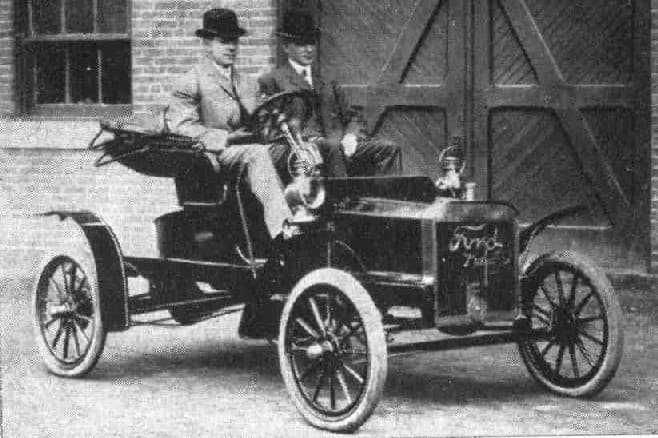
By 1903, multiple manufacturers had adopted the honeycomb radiator and begun enclosing it in arch-shaped metal shells — the first true "grilles" in the modern sense.
Key 1903 Models
- • Ford Model A (1903): One of Ford's first production vehicles, featuring a front-mounted radiator with protective shell
- • Renault light cars (1903-1905): Used distinctive arch-shaped bodies to protect honeycomb cores
- • Various Mercedes models: Continued refining the integrated radiator housing design Maybach pioneered
The arch shape served both function and aesthetics — protecting the delicate honeycomb core while allowing maximum airflow through the curved opening.
1904: Rolls-Royce Creates Its Iconic Shape
In 1904, Rolls-Royce established what would become one of the most recognizable grille designs in automotive history.
According to Rolls-Royce historical records:
- • 1904: The famous Rolls-Royce radiator shape was devised
- • 1904: The entwined "RR" emblem was adopted as the company symbol
- • 1906: The Rolls-Royce 40/50hp (later named Silver Ghost) debuted at the Olympia Motor Show in London
The upright, rectangular Rolls-Royce grille — sometimes called the "Parthenon grille" for its temple-like proportions — became a brand identifier so powerful that it has remained essentially unchanged for over a century.
Silver Ghost Production
- • Production years: 1906-1924 (19 years)
- • Clientele: Royalty, aristocracy, and industrialists worldwide
- • Legacy: Established the luxury car grille as status symbol
1908: Ford Model T Democratizes the Grille
The Ford Model T, introduced in October 1908, brought the front-mounted radiator grille to mass-market automobiles:
- • Production: Over 15 million units (1908-1927)
- • Grille design: Simple brass radiator shell, later steel
- • Impact: Made the front grille a universal automotive feature
While the Model T's grille was purely functional, its ubiquity established the expectation that all cars would have a distinctive "face."
1911: Two Landmark Developments
The year 1911 saw significant innovations from both Mercedes and Rolls-Royce:
Mercedes: The Vertical Fold Design
Mercedes introduced a grille featuring a distinctive vertical fold down the center:
- • Purpose: Increased cooling surface area
- • Application: Reserved for powerful engine variants
- • Design: Created the characteristic "pointed" Mercedes front end
- • Legacy: Established the vertical design language that became an industry standard through the 1930s
This 1911 innovation marked the transition from purely functional radiator housing to intentional design element.
Rolls-Royce: Spirit of Ecstasy
Also in 1911, Rolls-Royce added its famous radiator mascot:
- • Designer: Sculptor Charles Sykes
- • Model: Eleanor Thornton (secretary to Lord Montagu)
- • Original names: "The Spirit of Speed," "The Flying Lady"
- • Official name: "The Spirit of Ecstasy"
- • Design: Female figure with outstretched arms, fabric billowing in the breeze
The Spirit of Ecstasy transformed the radiator cap into a branding element, pioneering the concept of the hood ornament.
1915: Cadillac and the V-8 Era
Cadillac's Type 51 of 1915 introduced America's first mass-produced V-8 engine, accompanied by a larger, more prominent grille:
- • Engine: 314 cubic inch (5.1L) V-8
- • Grille design: Upright, vertical-slat pattern
- • Significance: Larger engines required larger cooling capacity, driving grille size increases
The Type 51 helped establish the American preference for bold, chrome-accented front ends.
1920s: Chrome and Decorative Elements
The 1920s transformed the grille from functional necessity to decorative centerpiece:
- • Chrome plating: Became standard on premium vehicles
- • Vertical slats: Evolved from functional cooling fins to styling elements
- • Surrounds: Elaborate frames and moldings appeared
- • Hood ornaments: Following Rolls-Royce's lead, most manufacturers added mascots
By decade's end, the grille had become a primary brand identifier.
1931: The Modern Grille Is Born
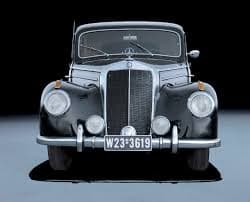
The Mercedes-Benz 170 of 1931 marked a fundamental shift in grille design:
- • Innovation: First vehicle with radiator mounted behind a protective grille
- • Significance: Separated cooling function from aesthetic design
- • Impact: Enabled designers to style grilles independently of radiator constraints
This architecture — decorative grille in front, functional radiator behind — remains the standard configuration in modern vehicles.
Timeline Summary: Key Grille Milestones
- • 1897: Wilhelm Maybach invents tubular radiator at Daimler
- • 1900: Honeycomb radiator debuts on Mercedes 35 PS
- • 1901: Patent DRP 122 766 granted (August 8)
- • 1903: Ford Model A and Renault use arch-shaped radiator shells
- • 1904: Rolls-Royce creates iconic rectangular grille shape
- • 1906: Rolls-Royce Silver Ghost debuts with standardized grille
- • 1908: Ford Model T brings grille to mass market
- • 1911: Mercedes introduces vertical fold design; Rolls-Royce adds Spirit of Ecstasy
- • 1915: Cadillac Type 51 V-8 establishes American grille vocabulary
- • 1920s: Chrome plating and decorative elements become standard
- • 1931: Mercedes-Benz 170 separates grille from radiator (modern configuration)
Legacy: From Function to Identity
The evolution documented here — from Maybach's 1897 cooling solution to the 1931 separation of form and function — established the grille as the defining visual element of automotive design.
Today, grilles serve primarily as brand identifiers: BMW's kidney grilles, Audi's single-frame, Lexus's spindle, and Jeep's seven-slot design all trace their DNA to the innovations of 1900-1931.
For enthusiasts exploring custom grille options, body kits, or front-end modifications, car visualization platforms like CarCustomizer.io allow you to preview how different grille styles will transform your vehicle's appearance before committing to modifications.
Conclusion
The car grille's history isn't vague — it's precisely documented through patents, production records, and manufacturer archives. Wilhelm Maybach's 1900 honeycomb radiator, Rolls-Royce's 1904 iconic shape, Mercedes' 1911 vertical fold, and the 1931 Mercedes-Benz 170's modern configuration represent specific, verifiable milestones.
These innovations transformed a cooling necessity into the automotive industry's most powerful design element — the face that gives every car its identity.